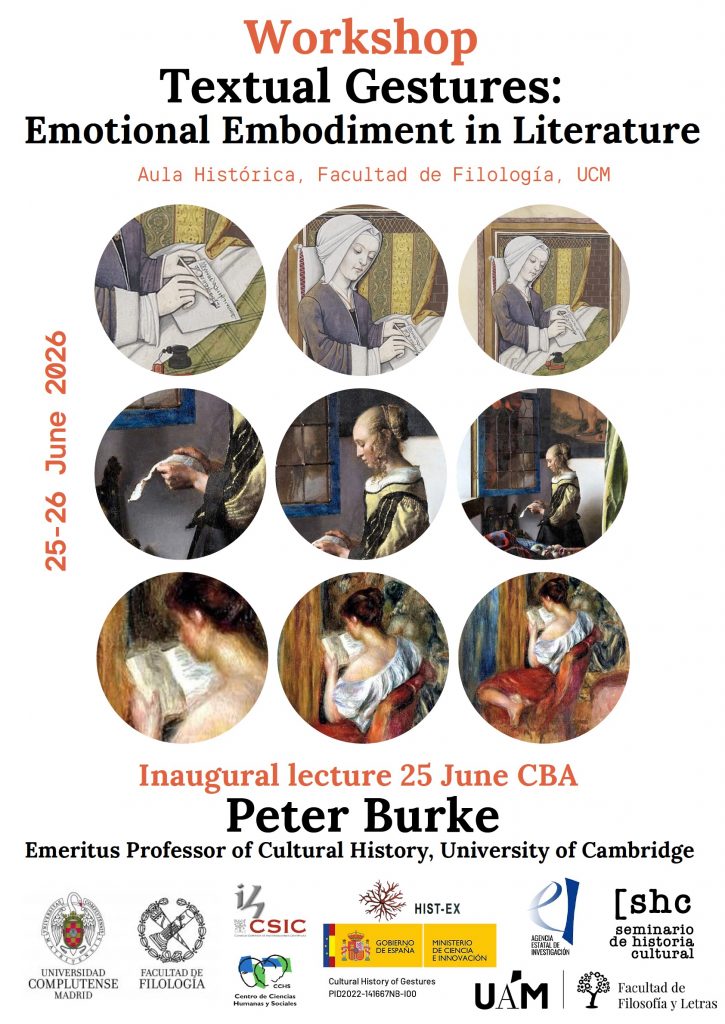
25-26 June 2026 / Aula Histórica, Facultad de Filología, UCM
Inaugural lecture: Peter Burke Emeritus Professor of Cultural History, University of Cambridge 25 June Círculo de Bellas Artes
As Yves Citton argues, “gestures are central to our aesthetic experiences” (2013, 285) in critical, political, and affective ways. Indeed, in his essay “Notes on Gesture,” Giorgio Agamben defines gestures as “neither production nor enactment, but undertaking and supporting” (2007, 140). A gesture, like literature, is not fact, but it may become a form of doing, an act of creating connection, or an event of meaning-making. According to Butler, following Adorno (2017, 184), it is in this threshold between feeling and saying, or between doing and saying, that gestures open the potential to establish meaning alongside, beyond, and against words. Gestures change bodily disposition, as Alice Butler, Nell Osborne, and Hilary White claim in the introduction to their recent edited volume (2025, 1), and therefore do something to our bodies, prompting us to respond. Yet this embodied response might entail change as well as repetition. Following Monique Sheer’s conception of emotions as a kind of practice (2012), which understands emotions as “emerging from specific bodily dispositions conditioned by a social context” (2012, 193), this workshop approaches gestures as a kind of “emotional practice”. Sheer’s configuration draws on Bourdieu’s idea of the “habitus,” of the conscious and unconscious training of the body, but also, in turn, of the limitations of this bodily conditioning. For Bourdieu, the “hexis” is the physical embodiment of the habitus and includes socially conditioned gestures and other bodily dispositions (2013, 17-18; 85-87). Gestures thus showcase emotions in a given context; however, not all gestures are intentional, as many emerge spontaneously or inevitably, such as blushing, clenching one’s jaw, bursting into tears, or showing disgust. Such gestures can be considered learned habits, or even feigned spontaneous gestures, as Tiffany Watt Smith argues about flinching (2014). Finally, reading and writing, as practices grounded in technologies, whether print or digital, may also lend themselves to involve gestural responses that may give way to emancipatory practices instead of repetition (Adema and Kuk, 2019).
This workshop will address the understudied topic of gestures in literature, not only in a more traditional (i.e., mimetic) representational sense, but also in relation to a broader understanding of gesture as a textual embodiment of emotion, the kinetics of texts, and, following Mark Amsler’s “affective literacy” (2001), as a somatic practice of reading (postures, physically manifested affective responses, and interactive engagements with texts such as reading out loud, underlining, or marking up). We are also interested in proposals about the performativity of literary gestures, and whether said performativity forecloses authenticity or opens up space for a response to what Judith Butler terms an “incomplete gesture” (2017), that is, “gestures that could not quite become actions” (2017, 182). How does literature enhance, hinder, or transform relational gestures?
Proposals may explore, though are not limited to, the following topics:
– Kinetic, mimetic, and non-mimetic representations of gestures in literary texts.
-Gestures and identity (gender, race, class, sexuality, ability).
-Tone as a textual gesture. Material gestures of reading and writing, in both print and digital cultures.
-Sincerity and authenticity vs. pretense of literary gestures.
-Performative gestures in literature.
Laura Fernández (U. Complutense de Madrid), Paul Michael Johnson (Johns Hopkins University), Javier Moscoso (CSIC), Saúl Martínez Bermejo (U. Autónoma de Madrid) and Lorena Santos de Torregroza (U. Complutense de Madrid).
Research Project “Cultural History of Gestures” (PID2022-141667NB-I00).
Important dates:
Deadline for proposal: March 2nd
Communication of acceptance: March 26th
Please send any queries to lauraparrafernandez@ucm.es and pmjohnson@jhu.edu.